

Hauraki Naturally
INSPIRING FREEDOM


The Spatial Management Feature: Private Security, Lazy Closures, and the Protected Perimeter
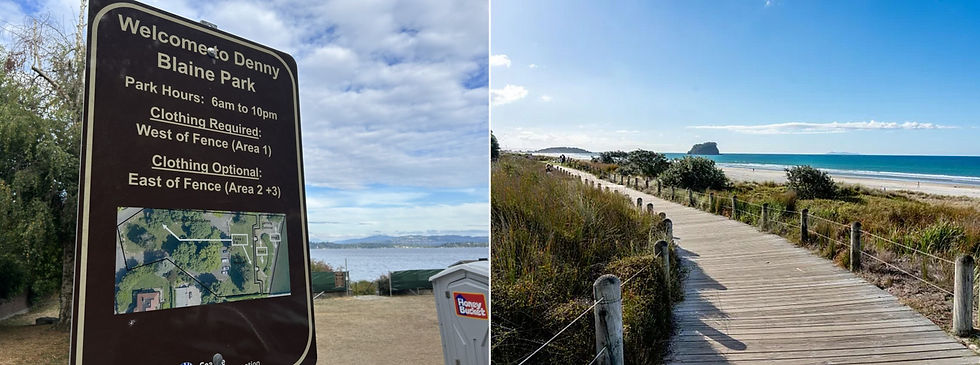
The Spatial Reality: The restrictive zoning map and fence layout at Seattle's Denny Blaine Park on the left, contrasted on the right by the open boardwalk and native screening solutions at Gisborne's Midway Beach that successfully preserved New Zealand's un-zoned clothes-free tranquility.

by Gull Sunderland
5 Jun 2026
How targeted over-policing in Seattle and a sweeping ban at Byron Bay reveal the corporate blueprints used to squeeze out clothes-free liberties—and why New Zealand infrastructure keeps our perimeters secure.
The traditional territories relied upon by clothing-optional networks are facing a synchronised global contraction. As private security coalitions and conservative local administrations tighten their physical perimeters, free-range naturists overseas face a critical operational challenge. Maintaining long-standing liberties requires an honest audit of recent spatial encroachments. From the targeted over-policing of a historical lakeside park in Washington State to sweeping bureaucratic shutdowns in Australia, the message is clear. The uncontrolled expansion of corporate-backed surveillance and municipal overreach is systematically squeezing customary recreation out of the public places framework.
Lake Washington Surveillance: Private Security and the Denny Blaine Enclosure
The first international flashpoint highlights how legally recognised clothing-optional sanctuaries can be strangled through privatised over-policing. In Seattle, Washington, an intense legal standoff has reignited over Denny Blaine Park along the shores of Lake Washington. Recognised as the state's first official LGBTQ+ historical nude beach, the site has been repeatedly targeted by wealthy nearby property owners using aggressive litigation frameworks. This coordinated neighbourhood pressure successfully forced the municipal authority to implement a strict, court-ordered abatement plan, slicing the compact park footprint into separate clothing-required and clothing-optional zones.
Moving into mid-May 2026, the situation has escalated far beyond standard municipal park enforcement. Park advocacy groups, led by the Friends of Denny Blaine coalition, have filed formal interventions in court revealing that wealthy neighbourhood associations are now funding private security guards. These private forces are actively patrolling the beach boundaries, wrongfully targeting topless swimmers, and physically restricting public access to the historical beach footprint. This corporate-backed surveillance model proves that local goodwill is highly vulnerable to wealthy privatisation. When a community fails to actively defend its regulatory perimeter, private security entities can easily be weaponised to enforce arbitrary boundaries on public land.

The Tyagarah Beach Precedent: Total Closure over Active Management
While the Seattle breakdown stems from corporate-backed security, a more direct threat of absolute state prohibition has manifested across the ditch in Australia. The Australian Naturist Federation has entered a critical mid-2026 legal battle with the New South Wales National Parks and Wildlife Service following the total closure of Tyagarah Beach near Byron Bay. The historical 800-metre clothing-optional zone was abruptly stripped of its status after conservative local lobby groups cited instances of lewd behaviour occurring in the adjacent sand dunes.
Instead of implementing targeted law enforcement or improving public infrastructure to manage the growing tourism numbers, the state administration applied a sweeping, lazy ban. This total closure has completely displaced traditional families who have safely and legitimately utilised the coast for decades. The Tyagarah precedent serves as an urgent warning for our New Zealand network regarding the "conservative creep" of regional councils. When tourist numbers increase, local administrations frequently prefer absolute prohibition over active, professional management, punishing law-abiding naturists for broader infrastructure failures.
The New Zealand Shield: The Myth of the Municipal Bylaw Ban
To understand how these international threats translate to our domestic shores, New Zealand trail-goers must understand the precise constitutional limits of local government power. Historically, conservative regional factions have attempted to mimic overseas crackdowns by passing local bylaws to prohibit public nakedness — most notably the historic, failed attempt by the North Shore City Council to ban naturists from Leonard's Beach. That local restriction failed completely because it proved fundamentally unenforceable under New Zealand administrative law. The legal reality is absolute: a local authority has the power to enact a bylaw, but that bylaw cannot impose a penalty or restriction greater than that of a national statute. Because parliament has established via the Summary Offences Act 1981 that recreational public nudity is not illegal, no municipal council has the authority to issue fines or criminalise simple clothes-free recreation. Any bylaw attempting to do so is legally invalid from the moment of its inception.
However, this statutory protection does not mean our community can become complacent. Because direct bans are legally impossible, councils frequently deploy back-door infrastructure tactics under the Reserves Act and the Resource Management Act to address public visibility complaints. Crucially, as our domestic newsroom audits reveal, these back-door methods do not have to be hostile; instead, they can represent highly intelligent public management solutions that stabilise local relationships. A classic domestic precedent occurred when the Gisborne District Council faced conservative local complaints regarding the customary clothing-optional zone at the southern end of Midway Beach. Acknowledging that a direct prohibition bylaw would instantly collapse under a constitutional challenge, the council instead utilised coastal land-use zoning and environmental restoration frameworks to execute a smart, structural compromise.
Rather than attempting to restrict the lifestyle itself, the Gisborne administration systematically re-routed the public walking tracks, established dense native vegetation screens to block direct lines of sight from the main boardwalks, and adjusted parking access boundaries. This structural intervention successfully eliminated the visual friction point for casual textile walkers while completely preserving the integrity and privacy of the underlying clothing-optional sanctuary. The Midway Beach compromise serves as a definitive case study for modern advocacy. It proves that while hostile overseas administrations panic and deploy lazy, sweeping prohibitions like the absolute ban seen at Tyagarah Beach, intelligent domestic authorities can utilise infrastructure adjustments to completely preserve the customary status quo.
The Strategic Counter-Measure: Preserving the Public Place Framework The synchronisation of these global pressure points provides an undeniable verdict for our editorial platform. We cannot afford to look the other way when external forces attempt to reshape the public places framework. Whether it is private security guards enforcing arbitrary lines in Seattle, sweeping bureaucratic bans eliminating beaches in Byron Bay, or localised infrastructure adjustments by domestic councils, the underlying mechanics remain identical. When a community relies on un-zoned public land, its stability depends entirely on maintaining excellent local goodwill and enforcing professional self-policing. Our newsroom continues to champion Hauraki Naturally's foundational Status Quo Plus pillar, recognising that attempting to aggressively force a confrontation during highly publicised administrative reviews only risks provoking regional councils into enacting permanent land-use restrictions.
Consequently, naturists and other clothing-optional advocacy groups would benefit hugely by following our lead in actively building and maintaining a friendly, cooperative working relationship with their local councils, the Department of Conservation, and the New Zealand Police. Proactively establishing open lines of communication builds high levels of mutual trust and professional respect in both directions, completely dismantling the adversarial dynamic that hostile outside lobby groups try to create. This collaborative approach paves a clear, sustainable way forward for better long-term recognition of the statutory rights of the clothes-free community. By applying the "who, what, why and when" to these international cases, we strip away the flowery illusions of permanent recreational freedom. The indisputable truth is that personal liberty is intrinsically bound to territorial awareness, administrative cooperation, and unwavering community vigilance and self-discipline.
