

Hauraki Naturally
INSPIRING FREEDOM


The Lowe Precedent: Kipling’s Faithful Men and the Akatarawa Ride
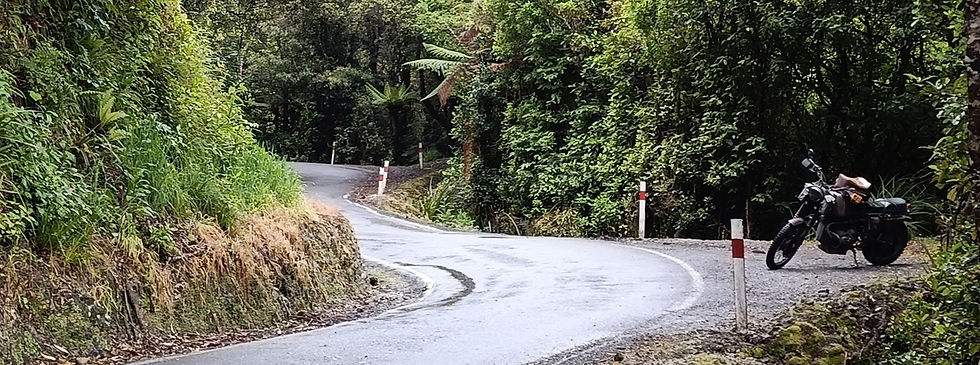
The winding, bush-clad Akatarawa Road, north of Upper Hutt: On World Nude Bike Day in 2009, this quiet stretch of the Tararua Ranges became ground zero for the High Court battle that helped define New Zealand’s right to be naked.

by The Naked Truth Investigative Team
27 Apr 2026
The $5,000 fight against a $200 fine: How a quiet ride on the Akatarawa Road established the high bar for body freedom in New Zealand law.
Rudyard Kipling once wrote about his "six honest serving-men" who taught him all he knew: What and Why and When, And How and Where and Who. When it comes to our right to be naked in New Zealand, these six men tell a story that every law man in a uniform needs to understand. Context, intent and effect are important ingredients in the decision whether to prosecute.
The When, The Who, and The Where
The When was March 15, 2009 — World Nude Bike Day. The Who was Nick Lowe, a veteran naturist who knows the value of therapeutic neutrality. The Where was the winding, bush-clad Akatarawa Road, north of Upper Hutt. It’s a quiet stretch of road where you’re more likely to see a pīwakawaka than a crowd, making it the perfect "office" for a man who prefers his cycling "un-lycra-ed".
The What and The How
Lowe was out for a ride in his "birthday suit," pedalling his machine through the hills. He wasn't making a scene; he was just a bloke on a bike. But the system decided to put on its academic costume. A female motorist, Ms Chamley, spotted him and phoned the police, later telling the court she was "fairly disgusted" by the sight.
Lowe was charged with offensive behaviour and slapped with a $200 fine and $130 court costs by a panel of Justices of the Peace in the lower court. The system took one person's subjective "disgust" as the benchmark for the whole community.
The Why: The High Bar of Justice
Nick Lowe didn't take it lying down. He spent roughly $5,000 to fight that $200 fine — not for the money, but for the principle. In March 2010, Justice Clifford at the High Court flicked the switch on the "disgust" argument. He determined that the Justices' conclusion that Mr. Lowe's behaviour was offensive was deemed incorrect, and that their assessment of Ms. Chamley’s reaction as "quite concerned" indicated they applied a lower standard than required. He noted that Ms. Chamley’s testimony did not demonstrate substantial offence, as she expressed curiosity and mild disgust rather than outrage.
The Why of his ruling established the gold standard for New Zealand: for behaviour to be legally "offensive," it has to be capable of "wounding feelings or arousing real anger, resentment, or outrage in the mind of a reasonable person." Justice Clifford noted that while the motorist was upset, being "fairly disgusted" by the human body on a quiet rural road doesn't hit that high bar. The conviction was quashed.
The Bottom Line
The Lowe Precedent remains one of the most important shields for body-freedom in New Zealand. It is a foundation stone in a growing wall of case law that proves the system requires actual harm, not just someone’s subjective discomfort. By fighting that $200 fine, Nick Lowe didn't just win a case; he established that the "reasonable person" isn't wounded by the sight of a bare back on a rural road.
It’s a high bar that the system still struggles to clear today. Whether it’s a cyclist in the Akatarawas or a protest on the world stage, the naked truth remains: until there is "real anger or outrage," the body is not a crime. Stay tuned as we head into May, where we’ll see how this "reasonable person" standard is being tested in courtrooms from Wellington to the United States.
